A guide to pantry storage jars
Start with the three staples you use most. Check whether each jar can hold the pack you buy, fit through the cupboard opening and leave room for your hand or scoop.
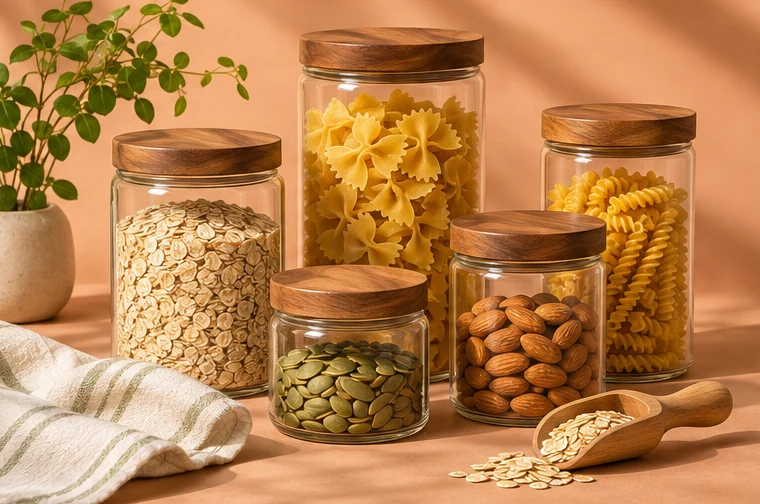
Start here
- Write down three staplesRecord the pack size you usually buy and whether you pour, scoop or pinch each ingredient.
- Measure the usable openingTake the height, width and depth inside the cupboard. Include any shelf lip, hinge or door frame in your measurements.
- Try a jar you ownUse it to check how much room you need to slide the jar out, open it and get the scoop in.
As an Amazon Associate I earn from qualifying purchases. Product pictures below are labelled illustrations of use. Check the current Amazon listing for exact specifications, availability and price.
Measure for the lid and your hand
Use the jar’s listed outside dimensions, including any latch. If the opening is 24 cm high, a 21 cm jar leaves 3 cm above it. Test whether that gap is enough for your grip and any shelf lip with a box of similar height.
For drawers, measure with the drawer shut and check for a rail or lip above it. Draw the base dimensions on scrap paper and arrange the cutouts on the shelf to see how many will fit.
Match jar volume to your grocery pack
Pack weight is usually in grams or kilograms, while jars are listed in litres. Packets of rice, oats and flour that weigh the same can take up different amounts of space. Use a clean, dry measuring jug to check the volume of the pack you normally buy, then allow room for the lid and a scoop if you keep one inside.
If you refill before a jar is empty, allow space for the leftover amount as well. For long pasta, compare the inside height with a dry strand and check how wide the opening is.
Choose a lid you’ll use every day
For flour or oats, compare the mouth width with the scoop you already use. For frequent use, check how the lid opens, whether it has parts you need to remove to clean it, and whether replacement gaskets or lids are available.
Compare the weight and grip of a filled jar if it will sit on a high shelf. Keep a small label with the ingredient name and the date or instructions from its packaging.
Arrange the shelf before buying more
Put daily staples where you can reach them without moving a second jar. Try short jars in front and taller ones behind, or group one task together, such as breakfast oats, nuts and seeds. For deep shelves, try a tray you already own so you can pull the back row forward.
Review the listing before ordering
Check which sizes the set actually contains, whether dimensions include lids, and whether the listing gives care instructions for each part. In customer photos, look for a jar beside a familiar object and check that the photo shows the same size and lid you selected.